What the Turnitin AI Report Actually Shows Your Professor
The AI writing indicator is not the similarity score. What your professor sees, what the percentage means, and what Turnitin says about its own limits.
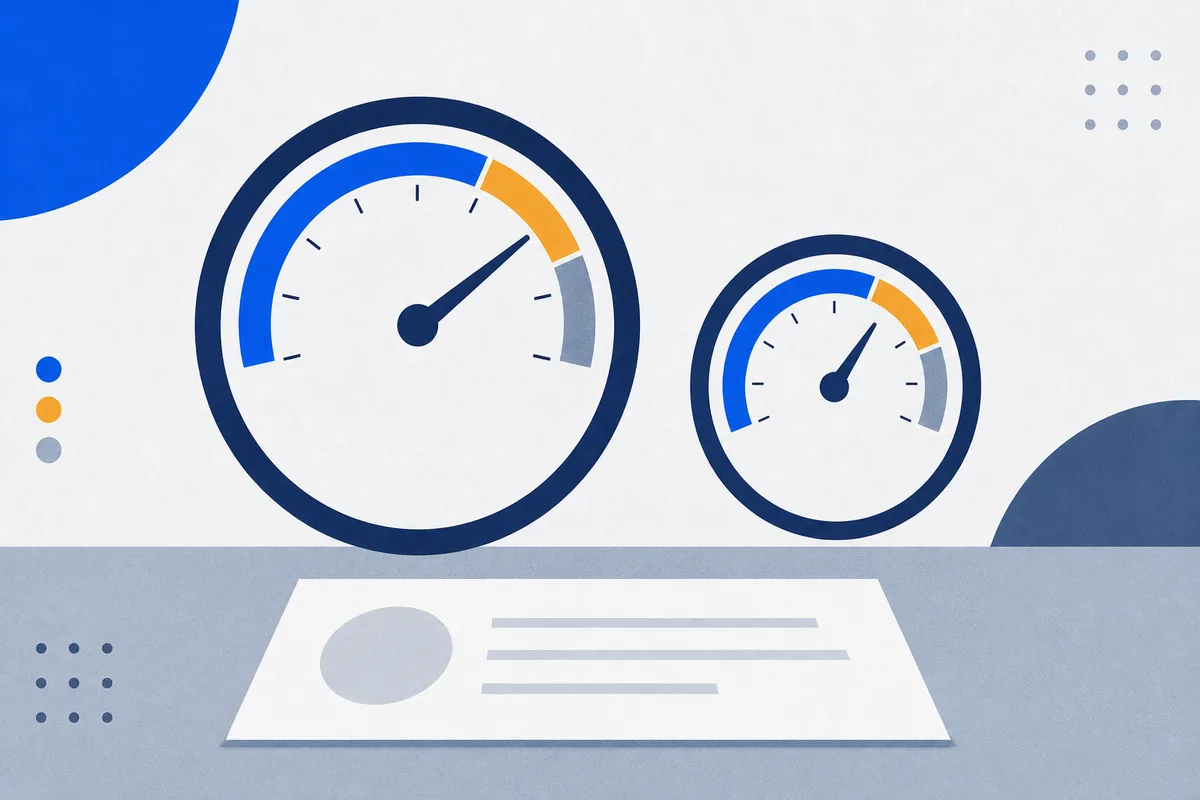
Almost every student has heard of the Turnitin percentage. Very few know there are two different numbers, that they measure unrelated things, and that Turnitin itself tells instructors not to treat one of them as proof.
Two scores, not one
The similarity score is the old one. It compares your text against a database of published work, web pages and previously submitted papers, and reports how much matches. A high similarity score often means nothing at all: quoted material and reference lists both match by design.
The AI writing indicator is separate and newer. It does not compare your work against anything. It is a classifier trained on student essays that estimates how much of your document reads as machine generated.
They can disagree completely. Zero similarity with a high AI score. High similarity with no AI flag. They are answering different questions.
What the AI percentage actually means
It is not a confidence level and it is not a probability that you cheated. Turnitin describes it as the percentage of qualifying text in the document that its model predicts was AI generated. The model works across a sliding window of prose, so it is making a call on segments and reporting the total.
It only runs on long form prose in English above a minimum length. Lists, tables, code and short answers are largely excluded, which is why a document can come back with no score at all.
What Turnitin says about it
Turnitin documentation states that the indicator is not a determination of misconduct and should be used as a starting point for a conversation with the student, not as evidence on its own. That guidance is written for instructors, and it is worth knowing it exists.
Some universities went further and turned the feature off entirely. Vanderbilt published its reasoning in 2023, citing false positives and the inability of the tool to explain its own scores.
What students usually get wrong about it
- Students generally do not see the AI score. It appears in the instructor view, so you may be discussing a number you have never seen.
- The percentage is not a similarity score, and the two are not comparable.
- A high score is not evidence of anything by itself, and Turnitin says so.
- A low score is not a guarantee either. Detection changes, and a result today is not a result next term.
If it comes up
Ask which number is being discussed. Ask to see the report. Bring your version history and your drafts. And be ready to talk about your argument, because the person who wrote something can always explain why they made each choice.
What we will and will not tell you
We are not going to claim we can predict what Turnitin will say. Nobody can: it is a closed model that changes, and any tool promising a guaranteed result is promising something it does not control. What we do is show you how your writing reads and which specific signals drive that reading, so you can decide what to do with it.
A reading and the reasons behind it, so you can judge it yourself.
See how your writing reads →Paste a paragraph. It scores instantly, in your browser, free.
A quick guide, not proof. Careful, formal, or non-native writing can read as AI; the full detector explains why.